Physical Address
304 North Cardinal St.
Dorchester Center, MA 02124
Physical Address
304 North Cardinal St.
Dorchester Center, MA 02124
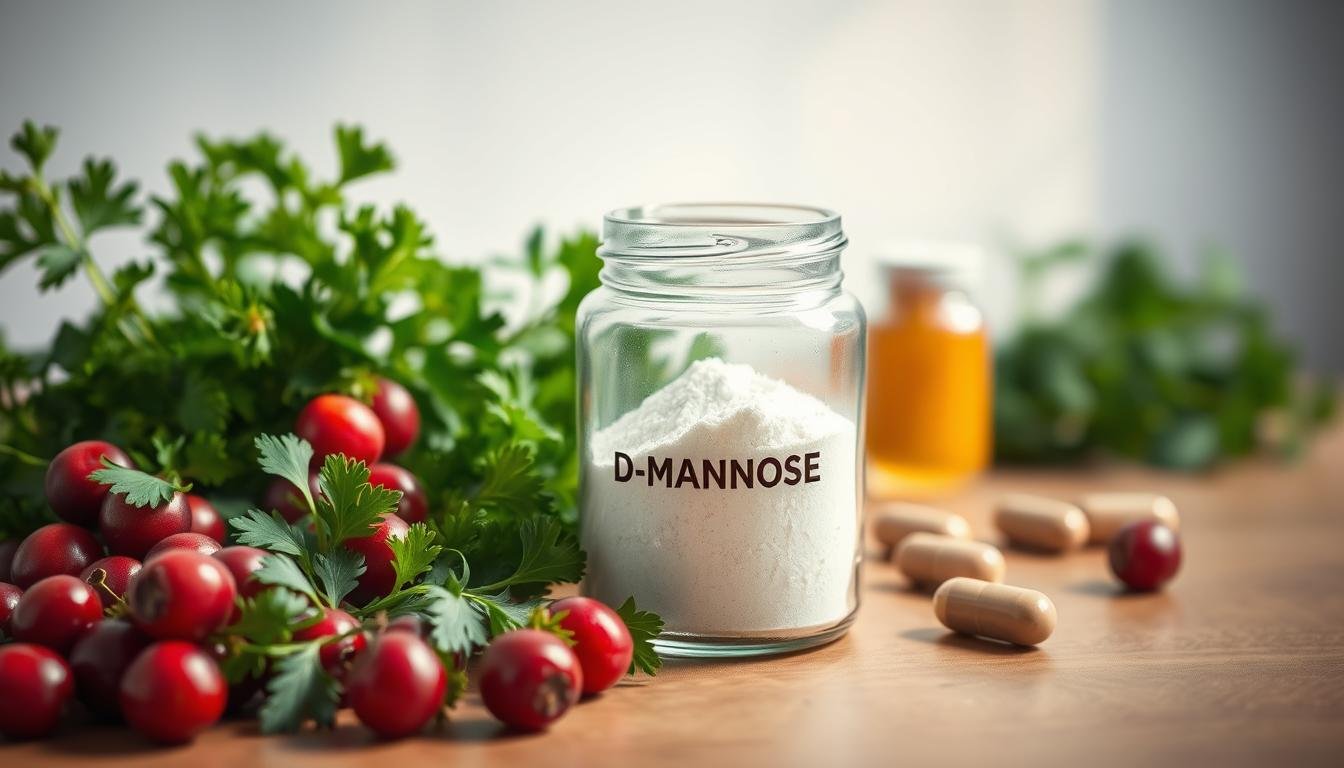
If you’ve had trouble with bladder infections, you might have heard about D-Mannose for UTI prevention. This natural sugar is seen as a possible antibiotic alternative. But is it effective?
Studies show mixed results. A study by Wagenlehner found that 85.7% of patients got better in just three days. That’s quite promising, isn’t it?
But a bigger 2024 study with 587 women had different findings. The UTI prevention supplement didn’t do much better than a placebo. About 51% of women taking it still needed medical visits, compared to 56% in the control group.
This supplement works by stopping E. coli bacteria from sticking to your bladder walls. Baylor College of Medicine research also shows it helps reduce stress in aging bladder cells.
In this guide, we’ll look at what science really says about this supplement. We’ll cover both the good and the bad, helping you make smart choices for your bladder health.

First, let’s understand what D-mannose is and how it works in your body. This knowledge helps you make smart choices about using this supplement. D-mannose’s role in fighting urinary tract infections is quite simple. We’ll explore what it is and how it helps.

D-mannose is a simple sugar found in foods like cranberries and apples. But, you get more from supplements than from eating these foods.
D-mannose is special because your body treats it differently than regular sugar. While glucose is used for energy, D-mannose mostly goes to your urine. This is key to its benefits for your bladder.
This unique way your body handles D-mannose is why it’s good for your urinary tract. It reaches your bladder in high enough amounts to help. Your body sees it more as a passenger than a food source.
Chemically, D-mannose is very similar to D-glucose but with a small difference. This small change makes a big difference in how it affects your body. Unlike glucose, it doesn’t raise your blood sugar levels.
The way D-Mannose for UTI prevention works is fascinating. It’s all about how bacteria attach to your bladder walls. Let’s dive into this process.
E. coli bacteria use special structures to stick to your bladder. These structures have proteins that bind to mannose molecules on your bladder cells. This is how they stay put and cause infections.
Your bladder cells have proteins with mannose molecules on them. The bacteria’s proteins latch onto these mannose molecules. This attachment helps the bacteria stay in place, even when you urinate.
D-mannose supplements add more mannose molecules to your urine. These molecules attract the bacteria’s proteins instead of your bladder cells. This stops the bacteria from sticking to your bladder walls.
This competition is the core of D-Mannose for UTI prevention. The bacteria can’t stick to your bladder because they’re bound to the D-mannose. They get washed out when you urinate.
Studies show that FimH adhesins are key for E. coli infections. These adhesins are found in many E. coli strains. This means D-mannose can help against most UTIs.
This method doesn’t kill the bacteria or affect their metabolism. It just stops them from sticking to your bladder. This is why D-mannose is seen as a good alternative to antibiotics for UTIs.
Every year, 150 million people worldwide deal with urinary tract infections. If you’re one of them, knowing about UTIs and D-mannose can help. This is about how bacteria cause infections and how supplements like D-mannose might stop them before symptoms start.
Women face a tough battle with UTIs. About 1 in 2 women will get a UTI in their lifetime. And, about 1 in 4 women who have their first UTI will get more, often within 6 months or a year.

UTIs don’t happen by chance. They start when bacteria from your gut, like E. coli, move to your urinary tract. Then, they go into your bladder, causing trouble.
E. coli is the main cause of UTIs. It has special proteins that help it stick to your bladder wall.
You have natural defenses against these invaders:
But sometimes, these defenses fail. When bacteria stick to your bladder wall, they multiply and form colonies. Some even make protective biofilms that hide from your immune system and treatments.
Several things increase your risk of getting a UTI. Being female is a big factor because your urethra is shorter. Other risks include having had a UTI before, being sexually active, having vaginal infections, diabetes, obesity, and genetic factors.
UTIs can come back, and it’s frustrating. Even with antibiotics, 20 to 30 percent of women will get another UTI within 4 to 6 months. This creates a cycle that’s hard to break.
D-mannose is a new way to prevent UTIs by stopping bacteria from sticking. Unlike antibiotics, it doesn’t kill bacteria. Instead, it gives bacteria something else to stick to.
Here’s how it works: E. coli bacteria use their proteins to stick to mannose molecules on your bladder wall. When you take D-mannose, you fill your urinary tract with mannose molecules. Bacteria then stick to these molecules instead of your bladder cells.
Once bacteria attach to D-mannose, your body’s flushing mechanism kicks in. Each time you pee, you get rid of the bacteria before they can cause an infection. This happens without harming your good gut bacteria or making bacteria resistant to antibiotics.
Studies have looked into whether D-mannose really works. A study by Kranjčec and colleagues found remarkably different recurrence rates. Women taking D-mannose had a recurrence rate of just 14.6%, while those without treatment had a 60.8% rate.
Another study by Domenici and team showed even better results. Their research found recurrence rates of only 4.5% with D-mannose compared to 33.3% without treatment. These findings suggest D-mannose could be a good option for those with repeated infections.
D-mannose is appealing because it’s a natural sugar that your body processes easily. Many see it as a gentler choice than antibiotics. This is important because antibiotics can harm your gut microbiome and contribute to antibiotic resistance.
But, more recent studies have shown mixed results. The scientific community is still studying D-mannose’s effectiveness. Not all studies have shown positive results.
If you’ve looked into bladder health support, you might have seen the buzz about D-Mannose. Let’s dive into what studies really say. The evidence is mixed, and it’s important to understand both sides.
Knowing the research helps you decide if D-Mannose is right for you.
Over the last decade, studies have shown promise for D-Mannose in preventing UTIs. A 2014 study by Kranjčec and colleagues found that 2 grams of D-Mannose daily helped women avoid UTIs better than antibiotics.
Women taking D-Mannose had a 14.6% recurrence rate, compared to 20.4% with antibiotics. Those without any treatment had a 60.8% recurrence rate.
Another study by Porru found even better results. Women using D-Mannose went an average of 200 days without another UTI. Those on antibiotics managed only 53 days.

A 2016 study by Domenici followed 43 women. They took 1.5 grams of D-Mannose twice daily for three days, then once daily for ten days. The results showed significant symptom improvement. Only 4.5% of women experienced recurrence when continuing prophylactic use, compared to 33.3% who stopped taking it.
More recent research by Wagenlehner examined outcomes in a non-interventional study setting. An impressive 85.7% of women treated with D-Mannose monotherapy were considered healed after just three days of treatment.
Research from Baylor College of Medicine explored cellular mechanisms. Scientists found that D-Mannose helps restore autophagy in aging bladder cells. It also reduces oxidative stress that builds up with age. This could explain why UTIs become more common with age.
These studies made many excited about D-Mannose as a natural bladder health support. The biological mechanism seemed plausible, and several studies showed benefits.
While early research was promising, recent studies have shown different results. A large 2024 randomized controlled trial published by the National Institute for Health Research changed the conversation significantly.
This study involved 587 women across 99 general practice clinics in England and Wales. Researchers followed participants for six months to compare D-Mannose against a placebo. The results were disappointing for those hoping this UTI relief supplement would prove effective.
After six months, 51% of women in the D-Mannose group contacted healthcare providers with suspected UTIs. The control group showed a similar rate of 56%. The difference was not statistically significant. More importantly, D-Mannose showed no reduction in laboratory-confirmed UTIs or hospital admissions.
This large, well-designed trial contradicts earlier positive findings. It represents the highest quality evidence we currently have about D-Mannose effectiveness.
The earlier studies had limitations. Many had small sample sizes—sometimes fewer than 50 participants. Small studies can produce results that don’t hold up when tested on larger populations.
Several earlier trials lacked proper placebo controls. Without comparing D-Mannose to an inactive substance, it’s impossible to separate true effects from placebo responses. Urinary tract infections naturally come and go, which makes proper control groups essential.
| Study | Participants | Key Finding | Limitation |
|---|---|---|---|
| Kranjčec 2014 | 308 women | 14.6% recurrence vs 60.8% without treatment | No placebo control group |
| Porru Study | 60 women | 200 days to recurrence vs 53 with antibiotics | Small sample size |
| Domenici 2016 | 43 women | 4.5% recurrence with prophylaxis | Very small sample, no placebo |
| NIHR 2024 | 587 women | No significant difference from placebo | Most rigorous design available |
Dosing protocols varied considerably across studies. Some researchers used 1.5 grams daily, while others used 2 grams. Treatment durations ranged from three days to continuous prophylaxis. These variations make direct comparisons difficult.
Different studies measured outcomes in varying ways. Some tracked only symptomatic UTIs, while others required laboratory confirmation. Some measured recurrence rates, while others looked at time until next infection. These methodological differences complicate our ability to draw clear conclusions.
The contrast between earlier positive studies and the recent large trial highlights an important principle in medical research. Small preliminary studies often show dramatic results that don’t hold up in larger, more rigorous trials. This pattern appears frequently in supplement research.
This doesn’t mean the earlier researchers were wrong or dishonest. It simply reflects how scientific understanding evolves. The biological mechanism still makes sense—D-Mannose does prevent bacterial adhesion in laboratory settings. But laboratory effects don’t always translate to clinical benefits in real-world conditions.
When you’re evaluating bladder health support options, this mixed evidence matters. The most reliable current evidence suggests D-Mannose may not prevent UTIs as effectively as earlier studies suggested. Yet, some people still report subjective benefits that research hasn’t fully captured.
D-mannose dosing varies based on whether you’re treating or preventing UTIs. Since it’s not FDA-approved, there’s no set dose. But, research offers guidelines for using this natural remedy for UTI.
Studies show different dosing amounts. Some focus on short-term treatment, while others aim for long-term prevention.

The amount of D-mannose you need depends on your goal. For treating UTIs, higher doses are used throughout the day. To prevent UTIs, lower doses are taken once daily.
Researchers have tried various approaches. Domenici’s team used 1.5 grams twice daily for three days, then once daily for 10 days. They also had a maintenance protocol of once-daily dosing for one week every other month.
Porru’s team took a different path. They prescribed three grams daily (split into three 1-gram doses) for two weeks during acute treatment. For prevention, they reduced this to one gram once daily.
The table below shows the various dosing protocols used in clinical research:
| Study Author | Acute Treatment Dose | Prevention Dose | Duration |
|---|---|---|---|
| Domenici et al. | 1.5g twice daily for 3 days, then once daily for 10 days | Once daily for 1 week every other month | Variable maintenance |
| Porru et al. | 3g daily (1g three times) for 2 weeks | 1g once daily | Long-term prevention |
| Kranjčec et al. | Not specified | 2g daily | 6 months |
| Wagenlehner et al. | 2g three times daily for 3 days, then twice daily days 4-5 | Not specified | 5 days total |
| NIHR Trial | Not applicable | 2g daily | 6 months |
The most common preventive dose is two grams once daily. Kranjčec’s research used this amount for six months of prevention.
Side effects were minimal in studies. Only 7.8% of patients reported diarrhea in one trial. Most people tolerated D-mannose well, even with long-term use.
“The advantage of D-mannose over antibiotics is the absence of antimicrobial resistance development and minimal side effects, making it an attractive option for long-term prevention strategies.”
Adherence can be a challenge. In the NIHR trial, more than two out of three participants reported taking D-mannose at least three days weekly for 15 weeks. This shows sticking to a daily routine can be hard.
How you take D-mannose is as important as the amount. Most researchers recommend taking it as a powder mixed with water. This form reaches your bladder more quickly than capsules might.
Timing is key to effectiveness. Many women find success taking it before bed since you naturally hold urine longer overnight. This potentially gives D-mannose more time to work in your bladder.
Here are practical tips for incorporating D-mannose into your routine:
Consistency is key for success. The NIHR study that found no significant benefit also noted imperfect adherence. When women missed doses regularly, the preventive effects diminished.
If you’re searching for the best D-Mannose brand, look for pure supplements without unnecessary fillers or additives. Quality matters when you’re taking something regularly. Check labels for third-party testing certifications.
You’ll want to monitor your body’s response during the first few weeks. Some people notice mild digestive changes initially. These typically resolve as your system adjusts.
Remember that adequate urine flow helps the process work. D-mannose binds to bacteria, but you still need to flush everything out. Drinking plenty of water throughout the day supports this natural mechanism.
Before starting any dosing regimen, discuss your plans with your healthcare provider. This is essential if you’re considering D-mannose as your primary prevention strategy. Your doctor can help you weigh whether this natural remedy for UTI fits your specific health situation and medical history.
Are you wondering if D-mannose can replace antibiotics for UTIs? Or should you stick with traditional medicine? Let’s dive into what each option offers and what science says.
Antibiotics have long been the go-to for UTIs. Doctors often prescribe fosfomycin trometamol, pivmecillinam, or nitrofurantoin first. These meds quickly kill the bacteria causing your UTI.
D-mannose takes a different tack. It stops harmful bacteria from sticking to your urinary tract walls. This approach is key to understanding when to use each treatment.
Antibiotics are super effective, curing over 90% of uncomplicated UTIs. You’ll start feeling better in 24 to 48 hours. But, 20 to 30% of women get another UTI within four to six months, even with antibiotics.
Studies have shown D-mannose might prevent UTIs. A study by Porru and colleagues found women taking D-mannose waited an average of 200 days for another UTI. Those on TMP-SMZ antibiotics waited just 52.7 days.
Kranjčec’s study showed D-mannose had a 14.6% recurrence rate, compared to 20.4% with nitrofurantoin. This suggested D-mannose could be effective in preventing UTIs.

But, recent findings are concerning. The large 2024 NIHR trial found D-mannose was no better than a placebo for prevention. This raises questions about earlier positive results.
Wagenlehner’s post-hoc analysis found 85.7% of women healed with D-mannose alone. Only 56.6% improved with D-mannose and antibiotics. The reasons for this are unclear.
For now, antibiotics are the best choice for treating UTIs. D-mannose hasn’t shown consistent success in getting rid of infections.
Side effects are a big part of this story. Nitrofurantoin caused side effects in 27.2% of women, including diarrhea and nausea. D-mannose, on the other hand, caused side effects in only 7.8% of women.
Antibiotics have long-term risks you should know about:
D-mannose is generally safe, with rare serious side effects. It doesn’t harm your beneficial bacteria like antibiotics do.
But, remember: safety without effectiveness isn’t helpful. Using D-mannose for active UTIs could let infections worsen or spread to your kidneys, leading to serious problems.
Antibiotic resistance is a big concern. Using antibiotics too much can make bacteria resistant to them. This makes finding new ways to prevent UTIs important.
Despite these risks, antibiotics are still the best choice for treating UTIs. The dangers of not treating UTIs are greater than the risks of antibiotics.
| Treatment Aspect | Antibiotics | D-Mannose | Key Consideration |
|---|---|---|---|
| Effectiveness for Active UTIs | Over 90% cure rate | No proven benefit vs. placebo | Antibiotics clearly superior for treating infections |
| Prevention Recurrence Rates | 20-30% recurrence within 4-6 months | Mixed results; 2024 trial showed no benefit | Evidence for D-mannose prevention is conflicting |
| Side Effect Frequency | 27.2% experience adverse effects | 7.8% report mild reactions | D-mannose has better tolerability profile |
| Impact on Beneficial Bacteria | Significant disruption of microbiota | No disruption to normal flora | D-mannose preserves healthy bacterial balance |
| Resistance Development | Contributes to antibiotic resistance | No resistance concerns | Long-term antibiotic use poses public health risks |
Your choice should depend on your situation. For active infections, antibiotics are the best choice. They quickly and effectively kill bacteria.
For preventing UTIs, the picture is less clear. While D-mannose showed promise, the latest trial found no benefit. Your doctor might suggest other prevention strategies.
Don’t rely solely on D-mannose for treating UTIs. But, talking to your doctor about prevention options is a good idea if you get UTIs often. Your doctor can help you decide based on your health and needs.
Wondering if D-mannose could help with UTIs? It depends on your health and risk factors. While research is still out, some groups might find it helpful. Talking to your doctor about it is a good first step.
Understanding your risk factors is key. Certain factors increase your chance of getting UTIs.
Women with frequent UTIs are the main focus of D-mannose studies. If you’ve had three UTIs in a year or two in six months, you might benefit. This affects millions of women, leading to endless antibiotic use.
Women are more at risk for UTIs than men. This is because of their anatomy. Most studies have been on women because of this.
Some activities and life events raise your risk. Being sexually active or having a history of vaginal infections can increase your risk. If UTIs bothered you as a child or before menopause, you’re more likely to get them later. Family history also plays a role.
Medical conditions can also raise your risk. Diabetes and obesity are examples. If antibiotics haven’t worked for you or you can’t take them, D-mannose might be an option.
Older women might find D-mannose helpful based on new research. Baylor College of Medicine found that aging affects bladder function. This makes older people more prone to infections.
D-mannose might help restore bladder function in older people. While it’s not proven to prevent UTIs in humans, it shows promise. Studies included women from 18 to 93 years old.
People with multiple sclerosis or other bladder issues might find D-mannose useful. A small study found it could reduce UTI frequency. Neurological conditions can make it hard to empty the bladder fully, leading to infections.
Timing D-mannose use might help if you notice UTI patterns. Some women get UTIs after sex or other activities. While it’s not proven, it’s a theoretical approach.
D-mannose seems safe for all ages, but caution is needed in some cases. Studies have included women from their teens to nineties without finding age-specific safety issues. This broad age range suggests it’s generally safe.
It’s been well-tolerated in research, with few side effects. No significant adverse reactions have been found. The Kranjčec study found no issues during treatment, which is good for long-term use.
But, some groups should be cautious or avoid it. People with diabetes should be careful because D-mannose could affect blood sugar monitoring. It’s similar to sugar and might interfere with glucose checks. Talk to your doctor before starting it, if you monitor your blood sugar.
Pregnant and breastfeeding women should not take D-mannose. There’s no safety data for these groups. UTIs during pregnancy need medical attention, so always consult your doctor.
If you have kidney disease, talk to your doctor first. D-mannose is processed by the kidneys, and kidney issues could affect how it’s handled. Your doctor can decide if it’s safe for you.
Most importantly, never use D-mannose instead of seeing a doctor for UTI symptoms. Signs like painful urination or fever need immediate medical care. Untreated UTIs can lead to serious kidney infections.
The postmenopausal period is a special case. Many women get more UTIs after menopause. The NIHR trial showed that 64% of participants were postmenopausal. Hormonal changes make them more susceptible to infections.
Children and adolescents are not well-studied with D-mannose. While UTI history in childhood increases adult risk, there’s little data on younger groups. Parents should talk to pediatricians before giving it to kids.
Deciding to try D-mannose should involve talking to your doctor. They can help you decide if it’s right for you. Even if you try it, don’t rely on it alone for protection. Keep up with regular check-ups and report any UTI symptoms.
Every supplement can have side effects, and D-Mannose for UTI treatment is no different. But, research shows it’s very well-tolerated compared to other treatments. Knowing what side effects might happen helps you use this natural remedy for UTI with confidence. Most people don’t have any bad reactions when taking D-Mannose for bladder health support.
Studies show D-Mannose is safe. Many research studies have looked at side effects, and the results are good. It’s safe to use D-Mannose for a long time.
Some people might get digestive upset, like loose stools or mild diarrhea. In one study, only 7.8% of patients taking D-Mannose got diarrhea. This is much less than the 27.2% who got side effects from the antibiotic nitrofurantoin.
Why does this happen? D-Mannose isn’t fully absorbed in your stomach. It can pull water into your intestines, causing loose bowel movements. This is more likely at higher doses.
Some people might feel bloated or have mild stomach discomfort when starting the supplement. These symptoms usually go away as your body gets used to it. The effects on your stomach can depend on the dose you take.
Skin reactions are rare. In one study, only one case of skin rash was found among 10 adverse events. But, it’s hard to say for sure if D-Mannose caused it, since some patients were also taking antibiotics.
It’s important to measure the dose correctly. Women using a scoop to measure D-Mannose powder might take too much or too little. This could lead to side effects or not work as well.
There’s a concern that D-Mannose might affect blood sugar in people with diabetes. But studies haven’t found this to be a problem. Still, if you have diabetes, it’s a good idea to watch your blood sugar when starting this supplement.
Many studies have shown that D-Mannose is well-tolerated. One study found no side effects even with long-term use. Another study said there were no side effects that stopped treatment long-term. Even in people with multiple sclerosis, there were no bad reactions.
| Side Effect Category | D-Mannose Frequency | Antibiotic Comparison | Severity Level |
|---|---|---|---|
| Digestive upset (diarrhea, bloating) | 7.8% of users | 27.2% with nitrofurantoin | Mild to moderate |
| Skin reactions | Rare (1% or less) | Variable by antibiotic | Mild |
| Blood sugar effects | Not documented in studies | Not applicable | Theoretical only |
| Serious adverse events | None reported | Occasional with antibiotics | Not applicable |
The risk of side effects with D-Mannose for UTI prevention is much lower than with nitrofurantoin. You’re about four times less likely to have side effects with D-Mannose.
While D-Mannose is generally safe, there are warning signs to watch for. Knowing these signs helps protect your health and ensures you get the right treatment.
Stop taking D-Mannose immediately if you have severe diarrhea, a lot of abdominal pain, or signs of dehydration. Dehydration symptoms include being very thirsty, not peeing enough, feeling dizzy, or having dark-colored urine. These symptoms need medical attention.
Any allergic reaction symptoms need immediate medical care. Look out for these signs:
Most importantly, see a doctor if you’re using this natural remedy for UTI and your symptoms get worse or don’t get better in 48 hours. This could mean the infection needs antibiotic treatment.
Signs that a UTI is getting worse include a fever over 101°F, back pain, nausea, vomiting, or getting worse symptoms. Never delay getting proper medical treatment for a UTI, as untreated infections can cause serious problems like kidney damage.
If you have diabetes, check your blood sugar more often when starting D-Mannose. Talk to your doctor if you notice any unusual changes in your glucose readings, even though studies haven’t found this to be a big problem.
For those using D-Mannose long-term for bladder health support, getting recurrent UTIs despite taking it regularly is another reason to talk to your healthcare provider. This might mean you need a better prevention plan or that there are other health issues to address.
Pregnant or breastfeeding women should talk to their healthcare provider before starting D-Mannose. While there are no reported adverse effects, it’s always better to be cautious during these sensitive times.
If you’re taking other medications or supplements, talk to your pharmacist or doctor about possible interactions. While D-Mannose doesn’t have known drug interactions, your healthcare team can give you personalized advice based on your health.
Once you know what D-mannose is and how it works, it’s time to learn how to use it every day. Many people use D-mannose to help with urinary tract health. It’s important to know the different forms and how to use them regularly.
Choosing the right product and making it a part of your daily routine is key. Studies show that sticking to a supplement plan can be hard. More than two out of three women in studies found it tough to take D-mannose every day.
D-mannose comes in several forms, each with its own benefits. The most studied is powder form, which you mix with water or other drinks. This is what most clinical trials used.
Powder is often cheaper and lets you adjust doses easily. It dissolves quickly in liquid, so your body absorbs it fast.
Capsules or tablets are also popular. They’re easy to take on the go. Just swallow them with water.
But capsules have downsides. You need to take several pills to get the 2-gram doses used in studies. They might take longer to reach your bladder than powder.
Some products mix D-mannose with other ingredients like cranberry extract or probiotics. These are marketed as all-in-one bladder health formulas. But, it’s hard to know which ingredient is helping.
When looking for the best D-Mannose brand, look for these qualities:
Remember, D-mannose isn’t FDA-regulated like prescription drugs. So, choosing quality products is crucial for your safety.
Adding any UTI prevention supplement to your routine needs practical strategies. Consistency is more important than being perfect.
Timing is key. Many women find taking D-mannose before bed works well. This gives it more time to work in your bladder, as studies suggest.
Setting reminders can help you stick to it. Try these tips:
If you’re using powder, mix it well in at least 8 ounces of water. This ensures it dissolves completely and helps flush your bladder. Some like the taste in plain water, while others prefer juice.
Remember to wait 30 to 60 minutes before urinating after taking D-mannose. This lets it concentrate in your bladder. Urinating right away reduces its effectiveness.
Drink plenty of water all day, no matter when you take your supplement. Staying hydrated helps with urinary tract health and flushing bacteria.
Clinical studies used different dosing schedules you might consider:
| Purpose | Dosage | Duration |
|---|---|---|
| Acute treatment | 2g three times daily | First 3 days, then twice daily |
| Daily prevention | 2g once daily | Ongoing for months |
| Intermittent prevention | 1.5g twice daily | One week every other month |
Keep a simple log to track your experience. Note when you take D-mannose and any UTI symptoms. This helps you see if it’s working for you, since everyone reacts differently.
Don’t rely only on D-mannose for UTI prevention or treatment. The best research hasn’t proven it works for everyone. Always talk to your healthcare provider about a complete prevention plan, if you get UTIs often.
Remember, supplements work best as part of a whole health plan, not alone.
Your doctor can help you create a plan that fits your needs. This might include lifestyle changes, good hygiene, and medical treatments when needed.
When looking at D-mannose as a natural remedy for UTI prevention, knowing the difference between food and supplements is key. This compound is found in plants, but getting enough from food alone is hard. Knowing where D-mannose comes from helps you decide if diet changes or supplements are better for you.
D-mannose is found in fruits and veggies. Cranberries have it, which is why they’re linked to urinary health. This makes D-mannose a popular choice for UTI management.
Other foods like peaches, apples, oranges, and blueberries also have it. Some beans and tree species have small amounts. Your body also makes a little D-mannose naturally.
But, food amounts are much less than what studies use. Studies use 1-2 grams of D-mannose daily. Fresh cranberries might have only a few milligrams, much less than needed.
Eating huge amounts of fruits to get enough D-mannose is not practical. It would also give too much sugar and calories. This could cause more health problems than it solves.
Eating fruits and veggies is good for health in many ways. But, they can’t give you the D-mannose levels needed for UTI prevention. The gap between food and study doses is too big.
If you’re thinking about D-mannose supplements, there are many options. Knowing these choices helps you pick the right one for your health goals and bladder health support.
Pure D-mannose supplements come from trees and are vegan-friendly. They let you take the exact amounts used in studies without extra stuff.
Many products combine D-mannose with:
While these combos seem good, there’s no solid proof they work better than D-mannose alone. They make it hard to know what’s helping you. Pure supplements give clearer results.
Supplements, not food, give the doses used in studies. But, eating fruits and veggies is good for overall health, including urinary health, in many ways.
Choosing between food and supplements depends on your goals. For UTI prevention, supplements are needed. For general wellness, eating D-mannose-rich fruits is good without needing supplements.
Dealing with recurring UTIs might make you want to try different treatments together. It seems like a good idea to mix various methods for better protection. But, combining D-mannose with other treatments is more complex than you might think.
Research shows some surprising things about mixing treatments. What works well together doesn’t always work as expected.
Combining treatments sounds promising. You might think D-mannose and other bladder health methods would work together well. Each could address different parts of UTI prevention.
For example, D-mannose might stop bacteria from sticking to your bladder wall. Probiotics could help beneficial bacteria fight off harmful ones. Postmenopausal women might use vaginal estrogen to keep tissues healthy, while D-mannose adds extra defense.
Some women mix D-mannose with cranberry products for urinary health. Others use it as part of a broader prevention plan. This plan includes staying hydrated, urinating after sex, and avoiding irritating products.
But, a study by Wagenlehner found unexpected results. It compared three groups of UTI patients over three days of treatment.
| Treatment Approach | Success Rate After 3 Days | Adverse Events |
|---|---|---|
| D-mannose alone | 85.7% healed | 3 out of 10 total events |
| D-mannose with antibiotics | 56.6% healed | 7 out of 10 total events |
| D-mannose with other measures | 56.3% healed | Not specified separately |
The group using D-mannose alone did better than the others. This challenges the idea that more treatments mean better results. The group using antibiotics with D-mannose had more side effects—7 out of 10.
What explains these findings? The comparison is tricky because the combination groups likely had more severe infections. But it clearly shows that combining treatments doesn’t always improve results.
NICE guidelines offer a broader view on prevention options. They recommend several proven approaches for recurrent UTIs:
The guidelines also mention cranberry products or D-mannose as prevention options. But these aren’t NHS-approved due to limited evidence.
If you’re dealing with recurring UTIs, a comprehensive approach might include multiple strategies with your healthcare provider. Don’t self-treat with unproven supplements.
The key is not relying solely on D-mannose. It should be part of a broader strategy, not a replacement for proven care.
Never delay or avoid appropriate antibiotic treatment for an active UTI in favor of trying D-mannose or other alternative approaches. This is the most critical precaution you need to understand. Untreated UTIs can progress to kidney infections, which are serious and potentially dangerous.
If you’re already taking antibiotics, you can generally continue D-mannose safely. The combination doesn’t appear to cause dangerous drug interactions. But, you should always inform your doctor about all supplements you’re using.
This transparency helps your healthcare provider make better decisions about your urinary tract infection treatment plan. They can monitor for any unexpected effects and adjust your care as needed.
If you have diabetes, discuss D-mannose with your doctor before starting it. D-mannose is a type of sugar, though it’s metabolized differently than glucose. It could theoretically affect blood glucose monitoring, even if it doesn’t significantly impact blood sugar levels.
Be cautious about taking multiple urinary tract supplements at once. Mixing D-mannose with cranberry, vitamin C, probiotics, and herbal products creates several problems:
If you’re considering preventive antibiotics—which do have proven effectiveness—taking D-mannose at the same time may be unnecessary. The antibiotic provides documented protection, and adding D-mannose likely won’t enhance that benefit based on current evidence.
Pregnant or breastfeeding women should avoid D-mannose entirely. There’s simply not enough safety data to confirm it’s safe during these critical periods. The potential risks outweigh any unproven benefits for bladder health support.
Maintain realistic expectations about what combining treatments can achieve. Adding D-mannose to other approaches doesn’t guarantee UTI prevention. Recent evidence shows it performs no better than placebo in rigorous studies.
Work with your healthcare provider to develop a comprehensive, evidence-based prevention strategy. This might include lifestyle modifications, appropriate medical treatments, and possibly D-mannose if you and your doctor decide it’s worth trying despite the uncertain evidence.
The goal is informed decision-making, not wishful thinking. Understand what each component of your prevention plan can realistically accomplish. Stay open to adjusting your approach based on what actually works for your body.
Remember that managing recurrent UTIs often requires patience and experimentation under medical supervision. What works for one person may not work for another. The combination approach that helps your friend might not provide the same results for you.
Choosing D-Mannose for UTI prevention depends on the science and your health. The research is mixed, so think carefully before deciding.
Early studies looked promising. They showed a big drop in UTI recurrences with this supplement. It works by stopping bacteria from sticking to your bladder.
The 2024 NIHR trial changed things. It found D-mannose didn’t work better than a placebo. About 51% of women in the study had UTIs, similar to the control group. This shows it might not be as effective as thought.
But, D-mannose seems safe. Only 7.8% of people in studies got diarrhea. It also doesn’t lead to antibiotic resistance.
If you have UTI symptoms, see your doctor. D-mannose shouldn’t replace antibiotics for treating infections.
For bladder health and prevention, talk to your doctor first. Drink plenty of water. Urinate after sex. If you’re postmenopausal, vaginal estrogen might help.
Try D-mannose as a low-risk addition to these methods. Keep track of your UTI frequency. Your experience is important, even if studies are mixed.
The best plan combines proven prevention and talking to your doctor. This way, you get what works best for you.
You’ve just deepened your knowledge about the benefits of D-Mannose. Now that you understand the importance of proactive care, the next step is finding the right supplement. For a complete and unbiased analysis of the market’s most discussed product, Click here to read our Full AZO Cranberry Pro Review: Ingredients, Price, and Where to Buy the Official Supplement and find out if it is the right choice for your urinary health
AZO Cranberry Pro provides daily protection for your urinary tract! With 600mg of Pacran (concentrated whole fruit cranberry), each softgel equals 1 glass of cranberry juice, but sugar-free and calorie-free. Helps cleanse and protect the urinary tract naturally. 100 softgels (50-day supply). Easy to swallow and gluten-free!
D-mannose is a sugar found in fruits like cranberries and apples. It’s thought to help prevent UTIs by binding to bacteria in your urine. This might help flush out the bacteria when you pee. But, a big study in 2024 found it doesn’t work better than a placebo.
There’s no set dose for D-mannose since it’s not a medicine. Studies have used 1-2 grams daily for prevention. For acute UTIs, doses range from 1.5 to 6 grams a day. It’s best to take it on an empty stomach and avoid peeing for an hour after.
No, antibiotics are much better at treating UTIs. They kill bacteria and work fast, often in 24-48 hours. D-mannose might not be as effective, based on recent studies.
D-mannose is usually safe, but it can cause loose stools or diarrhea. This is because it’s not fully absorbed by your body. Rarely, people might experience bloating or stomach discomfort. It’s safe for most people, but not for those with diabetes.
Women with recurrent UTIs might consider D-mannose. It’s not proven to work, but it’s low-risk. Pregnant and breastfeeding women, people with diabetes, and those with kidney disease should avoid it.
No, you can’t get enough D-mannose from food. Cranberries and other fruits have very little. You’d need to eat a lot of fruit to get the amounts studied in research.
Some studies suggest D-mannose works fast, but this is not confirmed. The most recent study found it no better than a placebo. If you try it, you might see relief in 24-48 hours.
Studies have used both approaches. For prevention, most used 2 grams daily. For symptoms, doses range from 1.5 to 6 grams daily. Consistency is key, but discuss with your doctor.
Yes, you can take D-mannose with antibiotics. However, antibiotics are still the best treatment for UTIs. Always follow your doctor’s advice on antibiotics.
D-mannose might work for UTIs caused by E. coli, but not for all UTIs. It’s not proven to work for all types of UTIs. Always see a doctor for proper diagnosis and treatment.
Both D-mannose and cranberry are linked to urinary health. Cranberries have D-mannose and other compounds. However, neither has strong evidence for UTI prevention. Both are safe, but their effectiveness is uncertain.
D-mannose is similar to glucose but is processed differently. It’s not a concern for blood sugar, but monitor it when starting D-mannose. Most people with diabetes haven’t seen problems, but it’s best to be cautious.
Men can take D-mannose, but it’s not proven to work for them. UTIs in men often need medical attention. Always see a doctor for UTI symptoms.
Try D-mannose for at least several months to see if it works. Keep track of your UTI frequency. If you still get UTIs, it’s not working for you.
Pregnant and breastfeeding women should avoid D-mannose. There’s no safety data for these groups. Always consult your doctor for UTI treatment during pregnancy or breastfeeding.
Look for pure D-mannose without additives. Powder forms are often cheaper and more convenient. Check for third-party testing like USP or NSF for quality assurance.
Studies have mixed results due to various factors. The 2024 NIHR trial was the largest and most rigorous. It found D-mannose no better than a placebo. The most recent evidence should guide your decision.
D-mannose is not proven to help interstitial cystitis or other bladder conditions. Always see a doctor for proper diagnosis and treatment of these conditions.
No, D-mannose doesn’t contribute to antibiotic resistance. It doesn’t kill bacteria like antibiotics do. However, it’s not proven to prevent UTIs, so it won’t help reduce antibiotic use.
Many take D-mannose before bed to help prevent UTIs. Take it on an empty stomach and avoid peeing for 30-60 minutes. Consistency is more important than timing, but the most recent study found it no better than a placebo.